Recently, the latest research results of Chunhong Ma, Chunyang Li and Xinyin Liu from Qilu Medical College of Shandong University were published in the journal Science Translational Medicine.
After screening more than 200,000 compounds, the research team successfully identified a small molecule compound, ML-T7, that targets TIM-3. Results of in vivo and ex vivo experiments showed that ML-T7 was able to enhance the anti-tumor activity of CD8-positive T-cells and CAR-T-cells, and that treatment alone directly inhibited the tumor progression in mice, and had a synergistic effect with PD-1 inhibitors.
TIM-3 is a membrane protein with a unique structure in its IgV structural domain known as the FG-CC' cleft, which is a highly conserved binding site for its ligand phosphatidylserine (PtdSer) and carcinoembryonic antigen-associated cell adhesion molecule 1 (CEACAM1).
TIM-3 is a membrane protein with a unique structure in its IgV structural domain known as the FG-CC' cleft, which is a highly conserved binding site for its ligand phosphatidylserine (PtdSer) and carcinoembryonic antigen-associated cell adhesion molecule 1 (CEACAM1).
In this study, the team identified ML-T7 from 204,380 small molecule compounds in the Specs database through a virtual screening combined with functional screening strategy.
Using techniques such as surface plasmon resonance (SRP) and molecular dynamics and crystal structure analyses, the team confirmed that ML-T7 can specifically target the FG-CC' cleft of TIM-3 and has a higher affinity for TIM-3 than PtdSer and CEACAM1. ML-T7 stabilizes its binding to TIM-3 through the FG-CC' cleft, disrupting the binding of TIM-3 to the PtdSer, CEACAM1 binding and interaction.
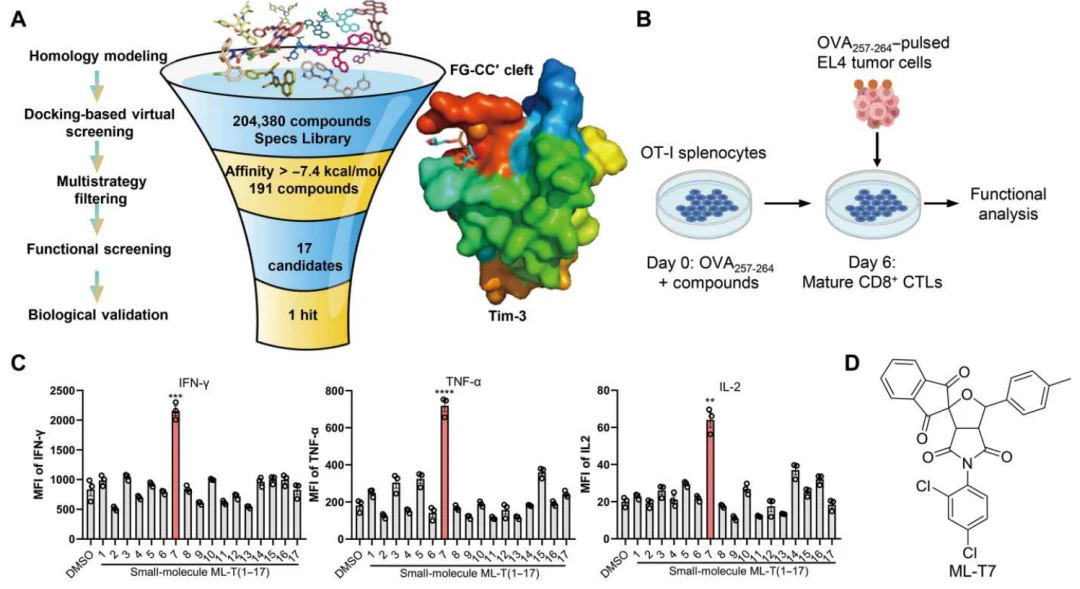
Screening and characterization of ML-T7
The results of in vitro experiments and mouse model experiments showed that by targeting TIM-3, ML-T7 was able to promote the survival, proliferation, and antitumor activity of CD8-positive cytotoxic T cells and prevent functional depletion.ML-T7 treatment resulted in the upregulation of the IL-2/STAT5 signaling pathway, the upregulation of effector factors such as IFN-γ, TNF-α, and IL-2, and the expression of activation markers (CD25 and CD69), and stem cell characterization-related cytokine (TCF1) expression levels were increased; on the contrary, the expression of depletion markers, such as PD-1 and CTLA-4, was decreased, and the proportion of terminally depleted T cells was downregulated.
Natural killer cells from the innate immune system, dendritic cells, and their functions were similarly negatively regulated by TIM-3. Especially in dendritic cells, there is also a specific high expression of TIM-4. The research team found that ML-T7 not only enhances the killing activity of natural killer cells, but also promotes the maturation of dendritic cells and enhances their antigen-presenting ability by acting on TIM-3 and TIM-4.
Using a variety of primary hepatocellular carcinoma mouse models, they observed the therapeutic effects of ML-T7. The results showed that treatment with ML-T7 at doses of 20 mg/kg or 50 mg/kg injected intraperitoneally every two days significantly inhibited tumor growth and prolonged the survival time of the mice and attenuated the immunosuppressive nature of the tumor microenvironment compared with the control group.
Further studies showed that 20 mg/kg ML-T7 treatment alone had similar anti-tumor activity to 100 mg/kg PD-1 inhibitor treatment alone, and the two had a synergistic effect when used in combination, reactivating CD8-positive T cells and natural killer cells in the tumor microenvironment. At 120 days after treatment with the combination, 50% of the mice survived (3/6 mice), whereas mice treated with ML-T7 or PD-1 inhibitor alone barely survived (0/6 mice or 1/6 mice survived).
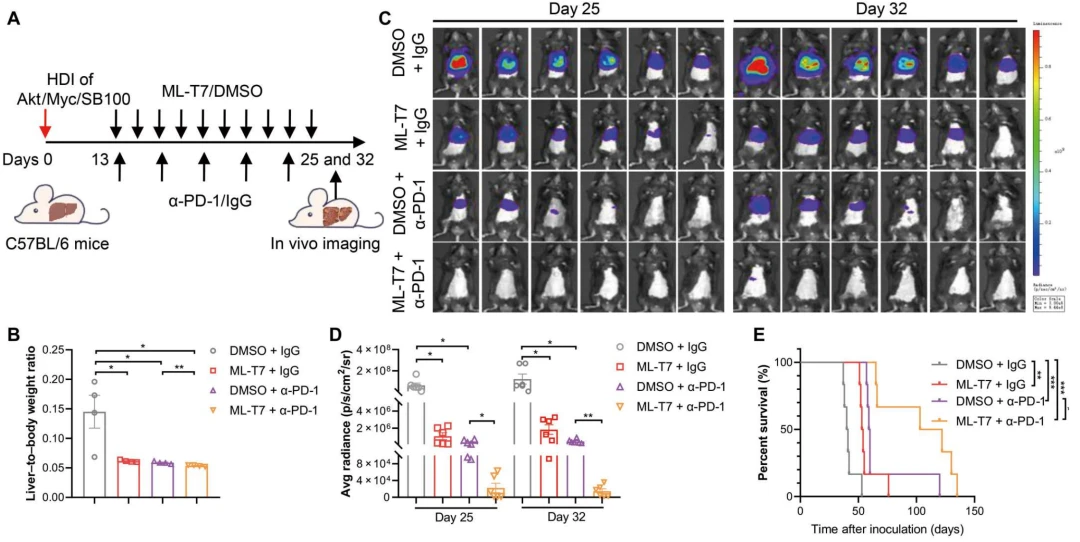
Effect of combination therapy with PD-1 inhibitors
In addition, ML-T7 treatment could significantly enhance the cytotoxicity of CAR-T cells against tumor cells, while inducing CAR-T cells to have reduced apoptosis and enhanced proliferation after overt metastasis. What's more, ML-T7 treatment effectively overcame the difficult problem in CAR-T cell therapy, i.e., preventing functional depletion, thus improving CAR-T cell efficacy, in which 10 μM ML-T7 was the most effective in reversing CAR-T cell depletion.
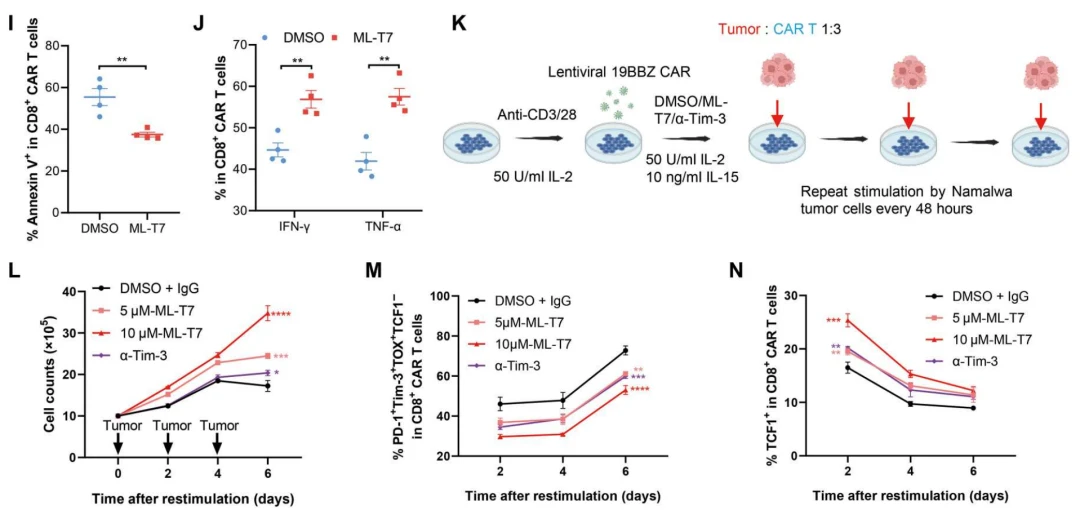
For enhancement of CAR-T cells
In terms of safety, ML-T7 was well tolerated, and treatment with a 50 mg/kg dose of ML-T7 injected intraperitoneally every two days did not result in significant adverse events in mice.
Overall, this study demonstrated the great potential of ML-T7, a small molecule inhibitor of TIM-3, for use in tumor immunotherapy.ML-T7 is not only good at fighting alone, but also able to enhance the anti-tumor activity of CAR-T cell therapy and PD-1 inhibitor therapy, which is safe and effective, and deserves to be further developed for clinical translation.