The Kirsten Rat Sarcoma Viral Oncogene Homolog (KRAS) is the most frequently mutated subtype of the RAS family, and was once considered an "undruggable" target. In recent years, covalent mutation inhibitors targeting the KRASG12C mutation have made significant breakthroughs, and two small molecule inhibitors, AMG510 (Sotorasib) and MRTX849 (Adagrasib), have been successively approved by the U.S. FDA, which has set off a wave of research on drugs targeting the difficult-to-drug target KRAS. However, there are still no drugs on the market for mutations other than KRASG12C, especially KRASG12D, which is widely found in many tumors, and recently, Mirati's MRTX1133, as the first orally reversible KRASG12D inhibitor, has just entered phase I, which has greatly boosted the research on drugs targeting this mutation.
Recently, the research team of Zhang Ao from School of Pharmacy, Shanghai Jiaotong University and the research team of Pang Xiu-feng from School of Life, East China Normal University have worked closely together to make progress in the study of anti-tumor small molecule inhibitors targeting the KRASG12D mutation. The work was recently published online in the internationally recognized academic journal Journal of Medicinal Chemistry: https://doi.org/10.1021/acs.jmedchem.3c01724.
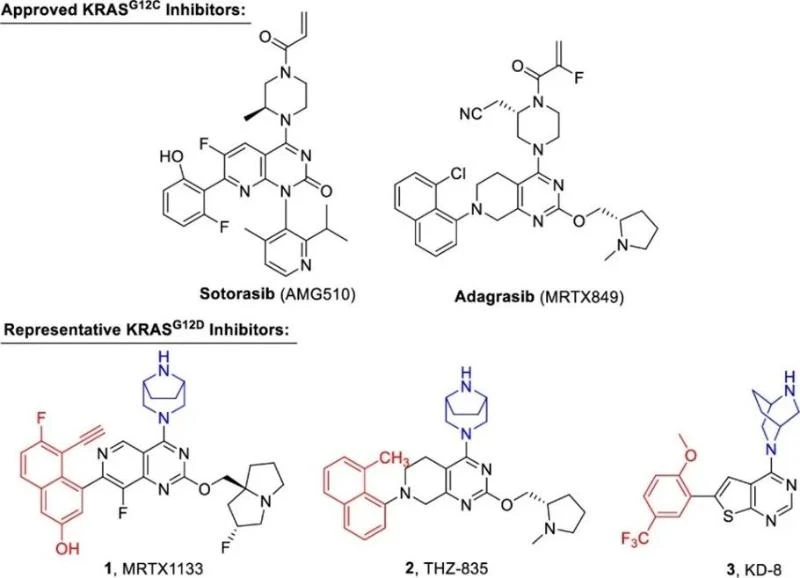
In this study, based on the crystal structure of the MRTX1133 complex, the researchers carried out systematic structural optimization of the P loop region occupied by the basic azetidinium bridging ring fragment, the hydrophobic pocket on the left side of the molecule where the naphthalene ring interacts, and the solvent region where the pyrrolizidine bicyclic ring interacts, on the one hand. In particular, the deuteration of benzyloxymethylene, a potential metabolic site, was carried out to increase the stability of the compounds, while the introduction of a sidodifluoroolefin substituent increased the novelty of the molecules, resulting in a class of pyrrolizidine deuterated compounds with sidodifluoroolefin substituents 22 and 28.

Figure 2. Structure-based drug design of new KRASG12D inhibitors.
Compounds 22 and 28 exhibited low nanomolar level (0.3 - 1.6 nM) growth inhibitory activity against cell lines such as AsPc-1 and AGS expressing the KRASG12D mutation, and weaker activity against other KRASG12S mutant strain A549 as well as KRASWT H1299 cells, showing better selectivity for KRASG12D. Subsequently, the compounds were found to be highly active in inhibiting RAF-RAS protein interactions at the molecular level by constructing a homogeneous time-resolved fluorescence (HTRF)-based assay (IC50 = 0.48 - 1.19 nM). Further in human pancreatic cancer cells AsPc-1 and intestinal cancer cells AGS, the new compounds dose-dependently and significantly inhibited the phosphorylation of KRAS downstream proteins ERK and AKT. Flow cytometric analysis likewise showed that the percentage of apoptotic cells after 24 hours of treatment via the compounds (50 nM) was approximately two times higher than that of the blank control group. In the AsPC-1 mouse xenograft tumor mouse model, the new compounds achieved 73.4% and 71.3% tumor growth inhibition (TGI) under intraperitoneal administration of 20 mg/kg twice daily, respectively, while there was no significant change in the body weight of the mice. Western-Blot analysis of the tumor tissues showed that the new compounds significantly inhibited the phosphorylation of KRAS downstream proteins ERK and AKT in vivo. Taken together, this suggests that this class of compounds has good safety and anti-tumor activity with potential for further research.
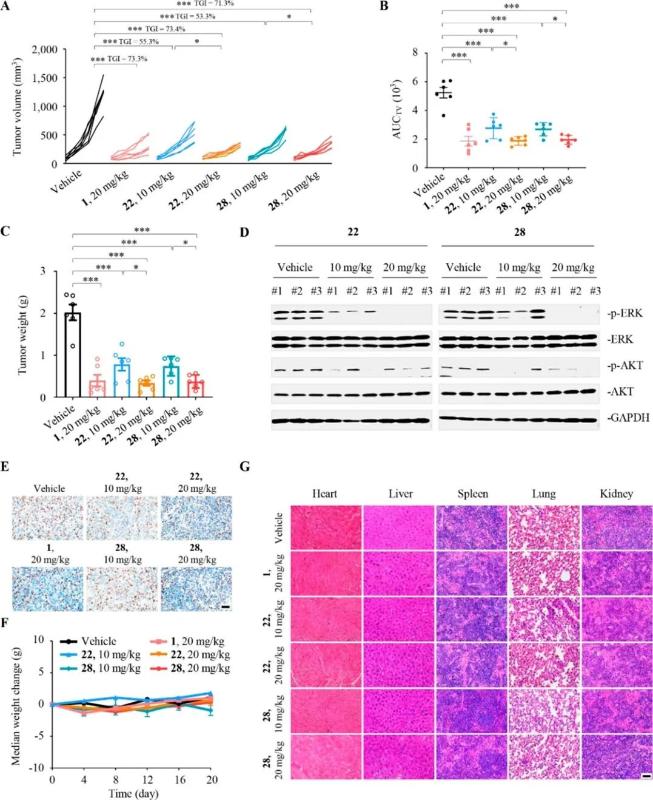
Figure 3. Anti-tumor effects of compounds in tumor xenograft mouse models in vivo.