The new brominated flame retardant decabromodiphenyl ethane (DBDPE) has been widely detected in a variety of environmental and biological media. Available evidence suggests that DBDPE may pose a direct exposure risk to wildlife and human liver tissue. Currently, studies on the hepatotoxicity of DBDPE have focused on the effects on metabolic functions, while there is a large gap in the understanding of the effects and mechanisms of liver early development and repair and regeneration processes.
The Environmental Toxicology Group of the Institute of Aquatic Biology, Chinese Academy of Sciences (IABAS), in collaboration with the Fish Ecology and Resource Conservation Group (FERCG), revealed the effects and potential molecular mechanisms of DBDPE on liver development and liver regeneration processes, using the liver-specifically labeled transgenic zebrafish Tg (fabp10a: dsRed; ela3l: EGFP) as a model. The related research results were published in Environmental Science & Technology.
Using zebrafish at early developmental stages as a model, the team found a significant decrease in fluorescence area and intensity of the liver in juvenile fish after DBDPE exposure (Figure 1), as well as a decrease in the expression of the hepatocyte marker gene fabp10a, suggesting that early exposure to DBDPE affects early development of the zebrafish liver. Further studies found that this may be related to cell cycle blockade and transcriptional repression of liver development-related genes (e.g. gadd45ba).
Further, this study used adult female transgenic zebrafish as a model, underwent partial hepatectomy after 28 days of DBDPE exposure, recovered in fresh water, and observed and counted the liver ventral lobe to intestine ratio at different time points. Liver regeneration curves indicated that DBDPE exposure significantly inhibited the regeneration process of adult zebrafish livers (Fig. 2). This work further confirmed the adverse effect of DBDPE on the liver regeneration process by immunofluorescence results of hepatosome ratio (HSI) and proliferating cell nuclear antigen in wild-type female adult zebrafish. In addition, liver transcriptome analysis revealed that abnormalities in cell proliferation regulation and lipid metabolism might be related to the inhibition of its regeneration process.
The above studies help to further explore the hepatotoxicity and potential mechanisms of DBDPE, suggesting that DBDPE may pose potential hazards to aquatic organisms and human health. The research was supported by the National Key Research and Development Program of China and the National Natural Science Foundation of China.
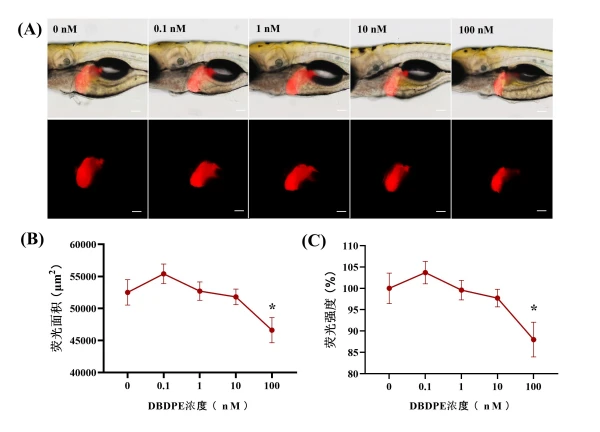
Effects of DBDPE on liver development in zebrafish larvae