Aging is a natural process that affects all living organisms, contributing to gradual changes in their behavior and capabilities, and previous findings have highlighted several physiological factors that may contribute to aging, including the body's immune response, imbalances between reactive oxygen species (i.e., free radicals) and antioxidant production, and sleep disorders. Although there is ample evidence revealing an association between organismal aging and these various factors, researchers still know very little about the links between them. In a recent study published in the international journal Neuron, entitled "A novel immune modulator IM33 mediates a glia-gut-neuronal axis that controls lifespan," scientists from the University of Washington and other institutions have shown that the immune modulator IM33 is a novel immune modulator. Scientists from the University of Washington and other institutions have identified a specific immune molecule that plays an important role in regulating the aging process and lifespan of organisms.
According to researcher Dr. Wangchao Xu, previous studies have identified a gene called Slpi that is perhaps the most highly regulated gene in the meninges of the aging mouse organism. The Slpi gene is evolutionarily conserved, and has a homologue in the Drosophila organism, called IM33, which may lead to a turn to Drosophila to study its important role in the aging process of the Drosophila organism, and to be able to capitalize on its strong genetics and short lifespan. Meanwhile, inspired by findings from other lab studies that cytokines shape the behavior of animal organisms, the researchers used Drosophila to screen for all the immune effectors that regulate Drosophila behavior, and found IM33 to be a sleep regulator.
After identifying specific mechanisms involved in aging in mice and finding that cytokines can influence animal behavior in two previous studies, the researchers realized that the two different physiological phenomena they had identified were related, and they began to explore the possibility of a link between the two. In this study, we utilized multidisciplinary approaches from genetics, neuroscience, immunology and microbiology, including genetic perturbation, behavioral assessment, microbial manipulation, imaging of neuronal activity, and molecular sequencing, with the aim of investigating the important role of IM33 in various aspects of organismal aging," said researcher Xu.
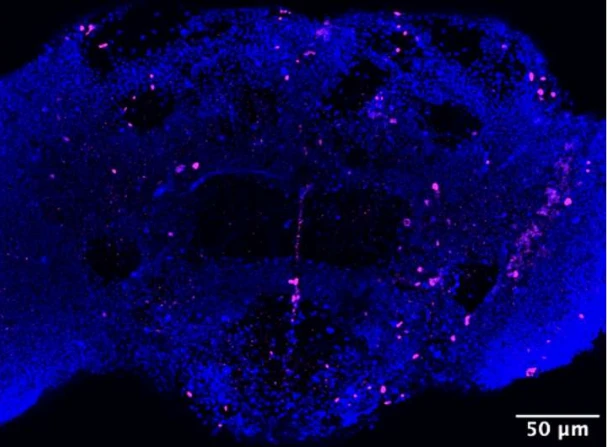
Identification of a specific immune molecule that regulates organismal aging and organismal lifespan.
Image From: Neuron (2023). DOI:10.1016/j.neuron.2023.07.010
The researchers used a wide range of experimental techniques to analyze both fruit flies and mice, in particular to try to understand the potential role of the mouse protein IM33 and its analog SLPI in controlling aging in their organisms; when the researchers knocked out the gene that expresses the protein from the fruit fly's immune cells, they found that this might increase the level of reactive oxygen species in the fruit fly's organism and alter the composition of the microbial community in its intestinal tract. The researchers found that knocking out the gene triggered sleep disturbances in Drosophila, which may also be associated with aging and shorter lifespan. This is a proof-of-concept study that suggests that an evolutionarily conserved immune molecule may be able to act as a messenger molecule, transmitting messages between the brain and the gut to regulate varying degrees of aging and control lifespan, a function that may go beyond the immune role it performs and further enhance the contribution of neuro-immune interactions to organismal aging.
The researchers are currently conducting studies aimed at better understanding the molecular mechanisms behind the neurology and genetics of aging, and future related findings may reveal the key roles played by the IM33 and SLPI genes, leading to further discoveries. As a conserved immune signaling pathway, peptidoglycan signaling in neurons may serve as a potentially novel target for slowing down aging in the body, the researchers said. The molecular mechanisms behind the brain's secretion of IM33 and thus shaping the gut immune environment are currently unknown to researchers, and furthermore, testing the role of meningeal SLPI in mice may help determine whether this is a common mechanism throughout evolution and could provide additional supporting evidence for future translational studies.
In summary, the results of this paper suggest that IM33 may play a role in the glial-microbial-neuronal axis, which connects neuroinflammation, ecological dysregulation, and sleep reduction during the aging process of the body, and that identifying the molecular mediators of these processes may be expected to aid in the development of innovative therapeutic strategies that can prolong lifespan.