Hangzhou Jeci Biochemical Technology Co., Ltd. is a physical and chemical enterprise mainly based on pharmaceutical and chemical industry. The company has been established for a long time. It is located in Shangcheng District, a feng shui treasure land in Hangzhou, Zhejiang Province. It is beautiful and rich, with outstanding people, convenient transportation and economic development.
Our company's various chemical qualifications and certificates are complete, there are a variety of pharmaceutical intermediates and precursor chemicals, and most of the common dangerous goods business qualifications, and have complete import and export qualifications, the company's products are sold all over the world, and Acting for the import and export of various products such as hazardous chemicals.
The company is mainly engaged in wholesale, retail, biological products, pharmaceutical intermediates, first-class medical equipment, petroleum products, rubber products, plastic products, biological reagents, biochemical testing reagents and consumables, chemical reagents; pharmaceutical operations (operating with valid licenses) Import and export of goods and technology (except for projects prohibited by national laws and administrative regulations, and laws and administrative regulations stipulate that projects that restrict operations can only be operated after obtaining a permit). (Projects subject to approval according to law may be operated after approval by relevant departments)
Our company's various chemical qualifications and certificates are complete, there are a variety of pharmaceutical intermediates and precursor chemicals, and most of the common dangerous goods business qualifications, and have complete import and export qualifications, the company's products are sold all over the world, and Acting for the import and export of various products such as hazardous chemicals.
The company is mainly engaged in wholesale, retail, biological products, pharmaceutical intermediates, first-class medical equipment, petroleum products, rubber products, plastic products, biological reagents, biochemical testing reagents and consumables, chemical reagents; pharmaceutical operations (operating with valid licenses) Import and export of goods and technology (except for projects prohibited by national laws and administrative regulations, and laws and administrative regulations stipulate that projects that restrict operations can only be operated after obtaining a permit). (Projects subject to approval according to law may be operated after approval by relevant departments)
In China, we have a strong collaborative R&D team, working in depth with new drug research institutes and multiple custom processing plants. We have very good domestic sales channels and have long-term relationships with domestic companies, including product applications, technology transfer, product supply, custom processing, and exclusive agents for multiple products in multiple regions. In addition, we also provide factory quality management system certification consulting services.
Internationally, we have long-term trade relations with India, Southeast Asia, South Korea, Japan and other markets, and provides products in the whole process of market and sales services. At the same time, we also provide product registration, consulting and sales channel expansion services for overseas companies in the Chinese market.

Flavonoids have long been a popular source for new drug research and development. But how many flavonoid compounds have actually made it into approved drugs?
A team from the Marine Traditional Chinese Medicine discipline at Shandong University of Traditional Chinese Medicine, in collaboration with the research group led by Prof. Zhang Peicheng at the Institute of Materia Medica, Chinese Academy of Medical Sciences, and the pharmaceutical big data service provider YAOZHI.com, conducted a systematic data mining and integration study. For the first time, they comprehensively reviewed the global progress in flavonoid drug development. The study, titled "Clinical development and informatics analysis of natural and semi-synthetic flavonoid drugs: a critical review", was published in the journal Journal of Advanced Research.
It is worth noting that, as of the time of data collection, the paper had been cited 35 times and was selected as a new ESI (Essential Science Indicators) Top 1% highly cited paper worldwide. The following provides a partial introduction to the study's content; the full text can be accessed by clicking "Read the original article" at the end of the text.
Flavonoids are a class of naturally occurring plant secondary metabolites with important biological activities, widely distributed in the plant kingdom. The term "flavonoid" was first proposed in 1947, initially referring mainly to flavonoids and their structural analogs with a C6–C3 unit (i.e., the 2-phenylchromone skeleton).
Since 1952, the definition has been expanded to include all compounds with a basic "C6–C3–C6" skeleton, composed of two benzene rings (A ring and B ring) connected by an oxygen-containing heterocycle (usually a pyran ring, i.e., the C ring), totaling 15 carbon atoms.
Based on differences in the oxidation level and saturation state of the C ring, as well as the position of the B ring attachment to the C ring, flavonoids can be further classified into 14 basic structural types: flavones, flavonols, dihydroflavones, dihydroflavonols, isoflavones, rotenoids, pterocarpans, anthocyanidins, flavanoids, chalcones, dihydrochalcones, aurones, homoisoflavonoids, and xanthones (Figure 1).
Due to their diverse chemical structures and significant pharmacological activities (e.g., antioxidant, anti-inflammatory, cardiovascular protection), flavonoids have long been an important natural source for early-stage drug discovery. To date, the total number of identified and reported flavonoid compounds exceeds ten thousand, and a considerable number of new structures continue to be discovered and reported each year.
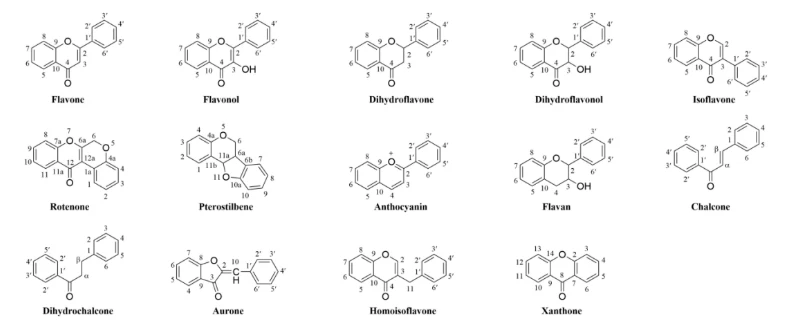
Figure 1 The 14 basic skeleton types of natural flavonoid compounds
Despite the large number of high-quality reviews published over the past three decades (1986–2022) systematically describing the potential therapeutic effects and mechanisms of flavonoid molecules in various human diseases, there remains a lack of a clear picture regarding exactly how many flavonoid derivatives have successfully progressed to candidate drug status and entered clinical application globally.
The specific research methods of this study are as follows: First, the authors utilized the "chemical structure drawing and retrieval" function of the PubChem database, using the 14 basic flavonoid skeletons (Figure 1) as templates to conduct a structure-based systematic search. After deduplication, more than 400,000 flavonoid compound records were extracted.
Second, the authors used key identifiers of these compounds-including the Chemical Abstracts Service Registry Number (CAS), International Nonproprietary Name (INN), and Chinese Approved Drug Name (CADN)-as search terms, inputting them into the YAOZHI Global Drug Analysis System (https://db.yaozh.com/) to comprehensively track their related drug development status information (such as preclinical studies, clinical trial phases, marketing status, etc.).
Subsequently, to ensure the accuracy and completeness of the data, the preliminary retrieval results were carefully cross-validated and supplemented with information from multiple authoritative databases and platforms, including ClinicalTrials.gov (clinical trial registry), AdisInsight (pharmaceutical R&D intelligence database), and Google Scholar (academic search engine). The verification covered core information such as the exact names of compounds, CAS numbers, Anatomical Therapeutic Chemical (ATC) classification codes, target indications, and originator institutions or companies.
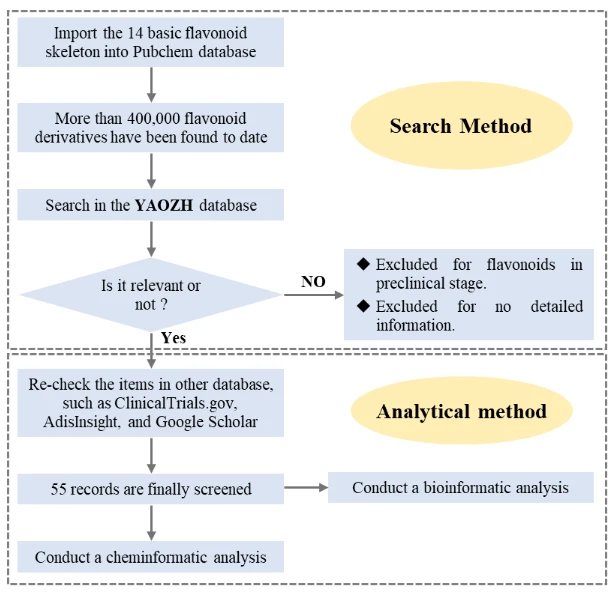
Figure 2 Search strategy and flowchart
Based on systematic investigation and data analysis, the research team found that a total of 19 flavonoid compounds clearly marked as drugs have been reported globally (Figure 3). According to their core skeletons, these were classified into seven flavones, two flavonols, two 3-methylflavones, one dihydroflavone, one dihydroflavonol, four isoflavones, one flavan, and one chalcone.
Detailed structural characteristic analysis revealed that two of the compounds are glucuronides, while four others contain the α-L-rhamnopyranosyl-(1→6)-β-D-glucopyranoside (rutinoside) moiety. Notably, one compound exists as an aluminum sulfate salt with a relatively large molecular weight (m/z 2133.65); another is a sodium carbonate salt with a smaller molecular weight (m/z 414.03). The synthetic pathway of this aluminum sulfate salt compound (presumed to be diosmin aluminum sulfate) can be traced back to hesperidin, which undergoes dehydrogenation to generate diosmin, followed by sulfonation to form a key intermediate, and finally combines with basic aluminum chloride.
In addition, three other compounds contain at least one nitrogen atom in their molecular structures. Among them, one compound is in the form of a quaternary ammonium salt, while the other two are non-salt compounds containing nitrogen-containing heterocyclic structural units.
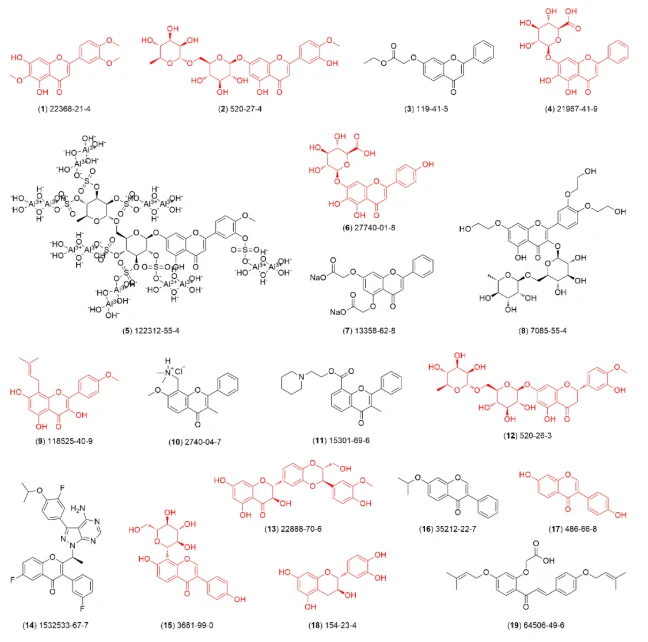
Figure 3 Currently marketed 19 flavonoid drugs and their CAS numbers (red marks indicate natural sources)
In addition, there are currently 20 flavonoid candidate drugs in clinical research, including 7 flavones (compounds 20–26 in Figure 4), 3 flavonols (compounds 27–29 in Figure 4), 3 dihydroflavones (compounds 30–32 in Figure 4), 2 isoflavones (compounds 33 and 34 in Figure 4), 4 flavanones (compounds 35–38 in Figure 4), and 1 chalcone (compound 39 in Figure 4).
Compared with the marketed drugs, these clinical candidates incorporate more heteroatoms in their structures (e.g., compounds 22–24, 33, 37, 39). Specifically:
Compounds 22 and 23 both have a piperidine ring attached at the C-8 position, with the C-2 position substituted by a chlorine atom, and the C7–OH of compound 23 is further modified with a phosphate group.
Compound 24 replaces the piperidine ring at C-8 with a tetrahydrofuran ring, and the C4–H is substituted by a trifluoromethyl group (–CF₃).
Compound 33 has a purine group linked to the C-2 side chain via an amine bond, and the C-30 position is substituted by a fluorine atom.
Compound 37 contains 4 fluorine atoms and nitrogen atoms in its molecule.
Compound 39 introduces a sulfur atom.
Besides heteroatom modifications, compounds 29 and 32 can be further classified as glycoside derivatives: the former is a pyranoglucose glycoside, and the latter contains an α-L-rhamnopyranosyl-(1→6)-β-D-glucopyranoside (rutinoside) moiety.
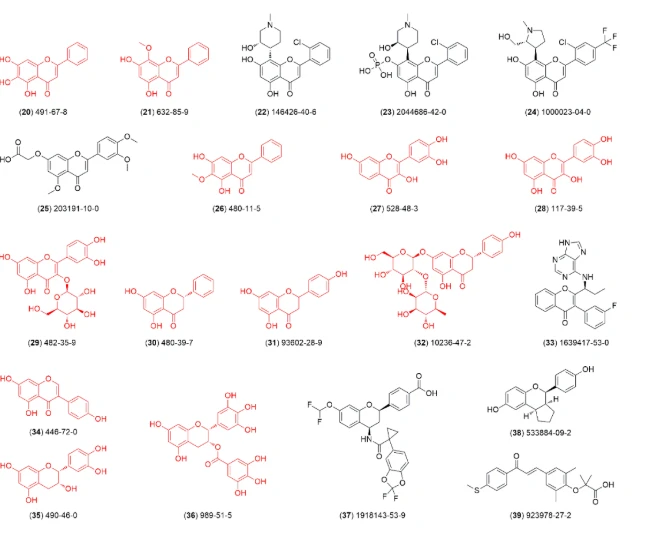
Figure 4 Flavonoid drugs currently in clinical research and their CAS numbers (red marks indicate natural sources)
The survey found that the development of a total of 16 flavonoid candidate compounds has been suspended (non-active status), including 6 flavones (compounds 40–45 in Figure 5), 3 3-methylflavones (compounds 46–48 in Figure 5), 2 dihydroflavones (compounds 49 and 50 in Figure 5), 1 3-methyl-dihydroflavone (compound 51 in Figure 5), 1 dihydroflavonol (compound 52 in Figure 5), 1 isoflavone (compound 53 in Figure 5), 1 flavan (compound 54 in Figure 5), and 1 chalcone (compound 55 in Figure 5).
Compared with the marketed drugs and clinical candidates, this group of compounds (e.g., 41–44, 46–48, 52, 53) exhibits the richest diversity of heteroatoms in their structures. For example:
Compound 41 has a tetrahydrofuran ring at the C-8 position and a chlorine atom at the C-20 position.
Compound 42 has an amino group substitution at the C-20 position.
Compound 43 contains 3 fluorine atoms at the C-6, C-8, and C-30 positions, and 2 amino groups at the C-5 and C-40 positions.
Compound 44 is formed by dehydration condensation between 3-(propylamino)propane-1,2-diol and the C7–OH group.
Compound 46 has a piperazine ring connected to the C-8 position via an amide bond.
Compound 47 has a piperidine ring connected to the C-8 position via an ester bond.
Compound 48 also has a piperidine ring in the C-6 side chain, and the molecule exists in the form of a quaternary ammonium salt.
Compound 52 is a complex of silybin (13) and phosphatidylcholine.
Compound 53's most notable structural feature is that its C-30 position is substituted by a sodium sulfonate group.
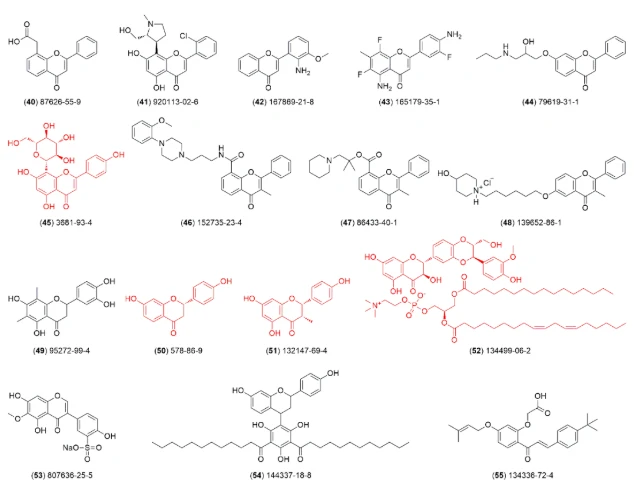
Figure 5 Flavonoid drugs with no updated clinical information or discontinued clinical trials and their CAS numbers (red marks indicate natural sources)
To further understand the chemical characteristics of the identified flavonoid drugs and clinical candidates, the authors performed a systematic chemoinformatics analysis using DataWarrior software combined with principal component analysis (PCA).
The specific analytical method is as follows: Based on referencing and appropriately modifying previously established methods, the open-source chemical data visualization and analysis software DataWarrior was used to calculate physicochemical property descriptors for each structure. These descriptors include: molecular weight (MW), number of hydrogen bond donors (HBD), number of hydrogen bond acceptors (HBA), calculated octanol–water partition coefficient (cLogP), calculated water solubility (cLogS), number of rotatable bonds (RotB), topological polar surface area (tPSA), fraction of sp³-hybridized carbon atoms (Fsp³), number of aromatic rings (RngAr), total molecular surface area (TSA, approximated using solvent-accessible surface area (SASA) with van der Waals radius and probe radius of 1.4 Å), relative polar surface area (relPSA, approximated using polar and nonpolar SASA), number of stereocenters (nStereo), number of stereocenters per molecular weight (nStMW), total number of rings (Rings), number of rings containing heteroatoms (RngH), proportion of heterocycles (RngHRs), proportion of aromatic rings (RngArRs), molecular shape index (ShapeIndex), and molecular flexibility index (MFlexibility).
Finally, to visually display the distribution and diversity of the compound set in chemical space, the authors employed principal component analysis (PCA), a multivariate statistical dimensionality reduction technique, projecting the complete descriptor dataset onto two or three dimensionless orthogonal principal component axes formed by linear combinations of the original variables, thus achieving its visualization.
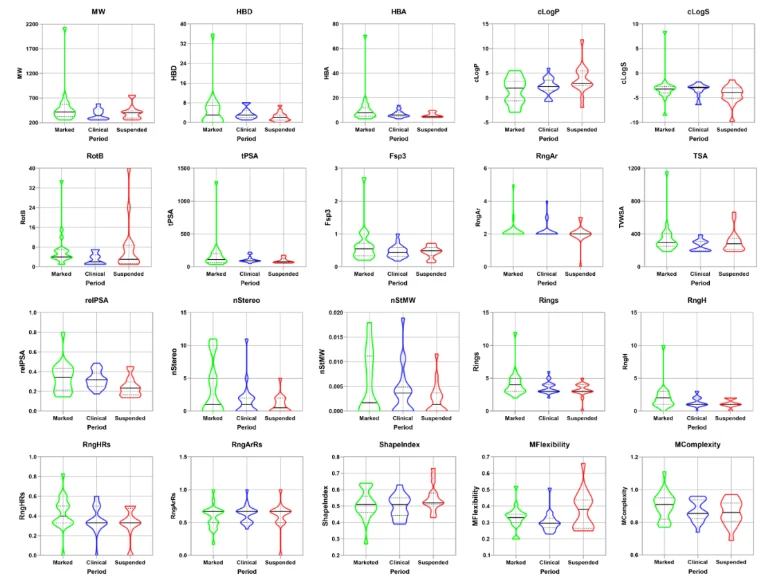
Figure 6 Comparative analysis results of physicochemical properties of marketed and candidate flavonoid drugs
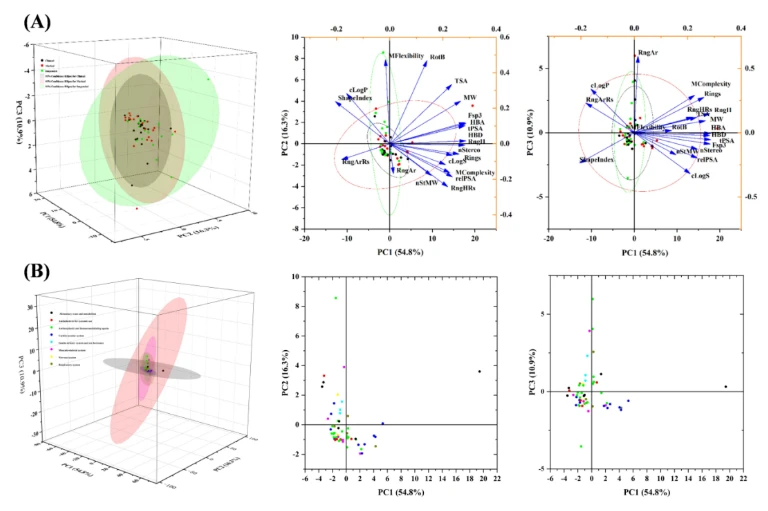
Figure 7 Principal component analysis based on the structure and physicochemical properties of flavonoid drugs
This study may represent the most systematic investigation to date of marketed and clinical candidate flavonoid drugs. Among flavonoid drugs, naturally derived flavonoid compounds account for 47.3%, indicating that the flavonoid scaffold remains an important source for discovering new drugs or active leads in pharmaceutical research and development.
Notably, flavonoid glycosides make up 36.8% of the marketed drugs. Although such compounds often do not conform to Lipinski's Rule of Five, they can still be successfully developed into drugs. One possible explanation is that the effect of glycosylation on the in vitro activity of flavonoids may differ from its actual impact in vivo. Specifically, upon oral administration, flavonoid glycosides frequently exhibit comparable or even stronger bioactivity than their corresponding aglycones, along with higher plasma concentrations and longer average residence times.
In addition, the study found that, compared with anticancer drug development, flavonoid compounds show a higher probability of successful development in the field of cardiovascular disease treatment.
This review provides a reference for subsequent research, helping to narrow screening ranges and reduce R&D costs. The core team members, Professor Xu Kuo and Associate Professor Ren Xia, are listed as co-first authors; Discipline Leader Professor Fu Xianjun and Researcher Zhang Peicheng from the Institute of Materia Medica, Chinese Academy of Medical Sciences & Peking Union Medical College, serve as co-corresponding authors. Furthermore, Wang Jintao, Deputy General Manager of Chongqing Kangzhou Big Data (Group) Co., Ltd. ("Yaozhi.com") consulting division, and Researcher Zhang Qin provided important technical support for this study.
It should be noted that although the authors have exhaustively retrieved relevant information, some details may still have been omitted, and constructive criticism and corrections are welcome.