Oil spills are disastrous for the natural environment because they cause long-term pollution that harms surrounding wildlife. However, certain oil-degrading bacteria are able to thrive in oil spill environments, contributing significantly to the bioremediation of oil spills. While communities formed by bacteria - biofilms - play a crucial role in the bioremediation of oil spills, how biofilms bind to oil in the ocean has been unclear.
In a new study, researchers from the Sorbonne University in France, the University of Toulon and the University of Tsukuba in Japan have made significant progress in elucidating the link between biofilm formation and oil degradation using a state-of-the-art microfluidic observation system. The system, combined with a high-resolution confocal microscope, helped to observe the interaction between bacterial cells and tiny oil droplets about half the diameter of a hairline. Their findings show that an oil-degrading bacterium, Alcanivorax borkumensis (Alcanivorax borkumensis), forms biofilms that consume oil by surrounding and strongly adhering to the oil-water interface. This bacterial community stretches oil droplets into many tubes, providing room for more bacterial cells to efficiently consume oil simultaneously. The findings are published in the August 18, 2023 issue of Science under the title "Alcanivorax borkumensis biofilms enhance oil degradation by interfacial tubulation ".
These authors observed this stretching mechanism at this oil-water interface by focusing on the dynamic process of tube formation. As the cells at this oil-water interface divide, the bacterial cells, which appear as small rods under the microscope, become tightly packed. In some regions, these bacterial cells showed a structure similar to the arrangement of petals of a wild daisy.
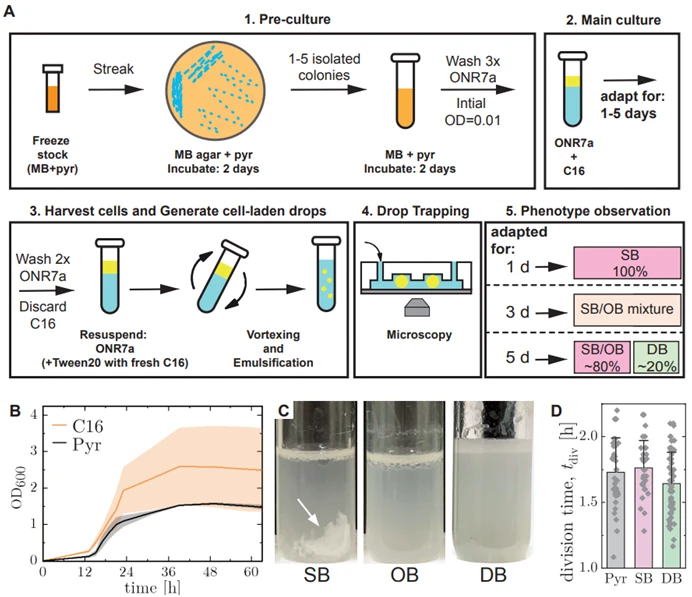
Schematic diagram describing culture methods for phenotypic characterization.
Image from Science, 2023, doi:10.1126/science.adf3345.
This arrangement, known as a topological defect in liquid crystal physics, begins to bulge outward from the droplet, causing this oil-water interface to deform and form a tube. These authors also successfully predicted the dynamics of biofilm formation and its qualitative shape using a theoretical physical model.
In addition, these authors confirmed that high concentrations of dispersants used during the cleanup of oil spills can adversely affect biofilms of alkane-eating bacteria on Porcupine Island, but further studies are needed to clarify their actual effects in the environment.
Thus, this new study provides insight into how bacterial communities can be utilized to enhance environmental remediation of marine oil spills. These authors suggest that understanding biofilm formation and bacterial cooperation could help utilize nature's efficient methods to improve the effectiveness of current oil spill cleanup processes.