Recently, in a study entitled "Location of CD39+ T cell subpopulations within tumors predict differential outcomes in non-small cell lung cancer" published in the international journal Journal for ImmunoTherapy of Cancer, scientists from the University of Edinburgh and other institutions revealed new findings on specific types of immune cells that may provide more accurate treatment for lung cancer patients. In a recent study published in the international journal Journal for ImmunoTherapy of Cancer entitled "Location of CD39+ T cell subpopulations within tumors predict differential outcomes in non-small cell lung cancer," scientists from the University of Edinburgh and other institutions revealed new findings on specific types of immune cells that may provide a more accurate prognosis for patients with lung cancer and better identify those who would benefit from immunotherapy.
In the article, the researchers found that the location of cytotoxic T cells in and around tumors, which play a key role in warding off cancer, may help predict patient survival and reveal whether therapies will work, and that the findings may pave the way for improved immunotherapies, powerful and expensive therapies that currently extend life expectancy that fail in 80 percent of cases. The researchers cautioned that further research and testing, as well as integration of new technologies, may be needed before they can be used in clinical practice.
Lung cancer, one of the most common cancers in the global population and a leading cause of cancer-related deaths, is usually diagnosed when it has progressed to an advanced stage, when conventional treatments tend to be less effective. In this study, researchers investigated why immunotherapy is not effective in treating human disease by analyzing molecules that interfere with the activity of T cells, a class of white blood cell types that defend against disease. Immunotherapy works by boosting the activity of cytotoxic T-cells, which patrol the body and detect and kill cancer cells, but often become "exhausted" when defending against tumors, and as tumors grow, they use complex mechanisms to avoid destruction, including interfering with the activity of immune cells such as T-cells. activity, such as T-cells.
The researchers analyzed tumor tissue from 162 patients with non-small cell lung cancer (NSCLC), the most common type of lung cancer, which accounts for more than 80 percent of lung cancer cases. The findings suggest that high levels of the enzymes CD39 and CD73, which are on the surface of many different types of immune cells, in tissues near tumors are often associated with reduced patient survival.There is a built-in safety mechanism in T-cells that is designed to prevent them from becoming overactive when fighting infection, and by increasing the levels of these enzymes, tumors can take advantage of this and avoid being destroyed.
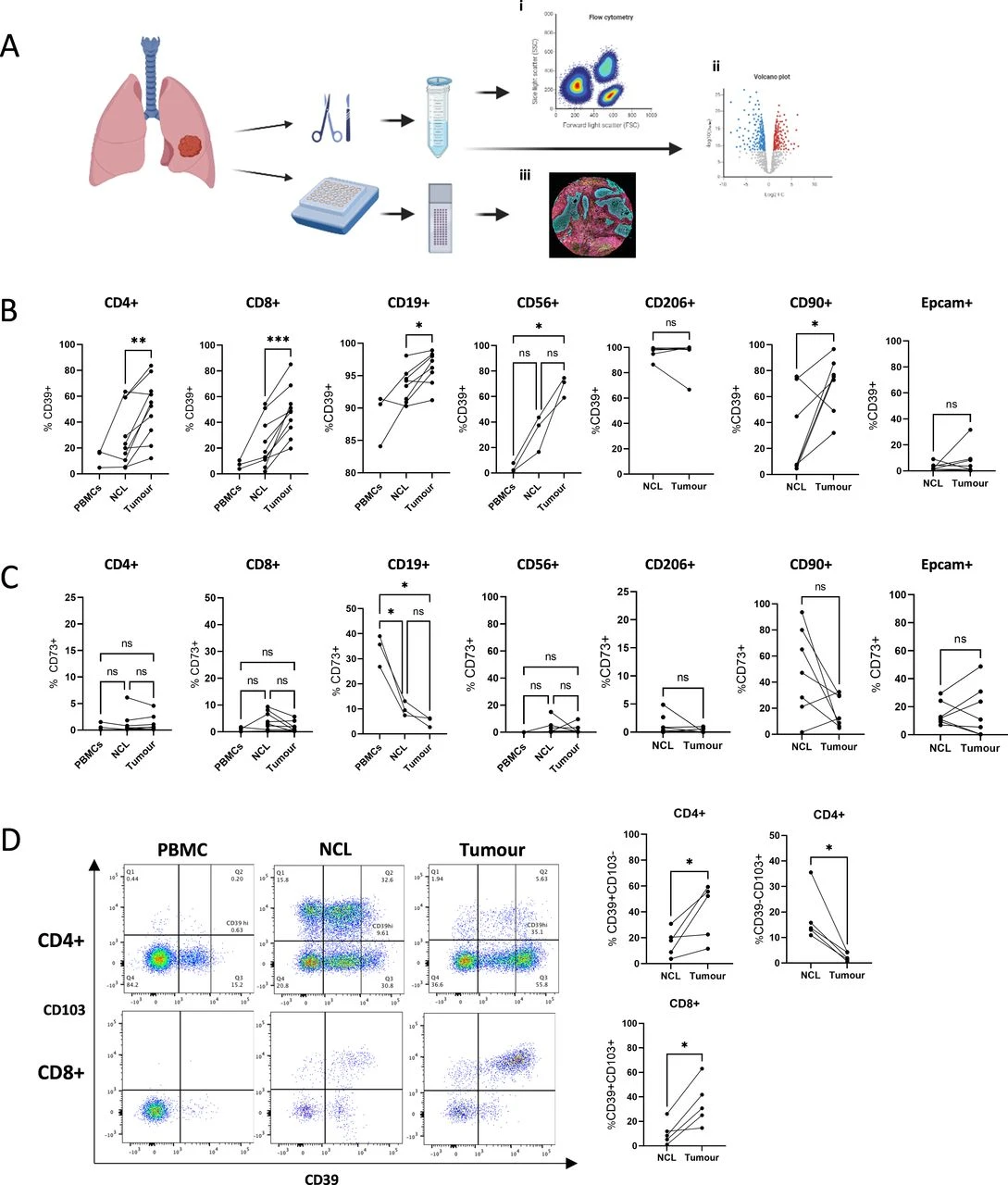
New discovery revealing T-cell populations promises to help enhance treatment for lung cancer patients.
Image from: Journal for ImmunoTherapy of Cancer (2023). DOI:10.1136/jitc-2023-006770
The researchers also found that the location and type of T-cells that express these enzymes may play an important role in helping the body predict patient prognosis and the success of immunotherapy, and that high levels of CD39 on the surface of cytotoxic T-cells located in tumor nests (clusters of cancer cells) may be associated with improved patient survival and a better response to immunotherapy. In contrast, when the same CD39 cytotoxic T cells were present outside these tumor nests (in areas called stroma), they did not affect patient survival. High levels of CD39 on the surface of regulatory T cells are often associated with decreased patient survival, and they usually prevent the body's immune system from being overactivated. These findings may be consistent even when other factors are taken into account, such as the patient's age, the size of the tumor, and whether or not he or she received chemotherapy in addition to surgery.
Understanding the mechanisms that suppress T cells and control their location may help improve the outcomes of immunotherapy and better predict which patients will benefit from it. This study may help us understand that we need to know the type of T cell in the cancer cell and where it is located in the tumor, so we can begin to recognize the complexity of the problem we are facing," said researcher Ahsan Akram. We hope that these findings will help lead to more research in the future, as well as help identify patients who are better able to receive immunotherapy, and also identify patients who are not able to be treated with immunotherapy earlier so that they can try alternative therapies.
In summary, the results of this paper suggest that understanding the distribution pattern of the CD39+ T-cell population may help to better reveal its prognostic impact on human non-small cell lung cancer patients, and related studies are expected to better understand the spatial and functional characteristics of CD39+ T-cells as well as their significance on patient prognosis.