Since people first described bacterial spores - inert, dormant bacteria - more than 150 years ago, researchers from Harvard Medical School in the United States have solved a puzzle for biologists in a new study. They have discovered a new class of cell sensing proteins that enable spores to detect nutrients present in their environment and quickly restore vitality.
It has been proven that these sensing proteins are ion channels that pass through the cell membrane and remain closed during dormancy, but quickly open when they detect nutrients. Once opened, these ion channels allow charged ions to flow out through the cell membrane, initiating the protective shell shedding of spores and initiating metabolic processes after years or even centuries of dormancy. These findings may help to design a way to prevent dangerous bacterial spores from dormancy for months or even years and waking up again, leading to disease outbreak. The relevant research results were published in the April 28, 2023 issue of the Science journal, with the title "Background spore reduction receivers are nutrient gated ion channels".
David Rudner, the corresponding author of the paper and professor of microbiology at the Bravatnik Institute of Harvard Medical School, said, "This discovery has solved a problem that has existed for more than a century. When bacterial systems are almost completely closed in this protective shell, how do bacteria perceive changes in the environment and take action to break dormancy?"
How to revive dormant bacteria
In order to survive under unfavorable environmental conditions, some bacteria enter a dormant state and become spores. Biological processes are suspended, and their cells are surrounded by multiple layers of protective shells. These inert protective shells allow bacteria to wait for the end of famine and protect themselves from extreme heat, drought, ultraviolet radiation, irritating chemicals, and antibiotics.
For over a century, scientists have known that when spores detect nutrients in their environment, they quickly remove their protective shells and reignite their metabolic engines. Although the sensing proteins that enable them to detect nutrients were discovered nearly 50 years ago, the method of transmitting wake-up signals and how this signal triggers bacterial recovery remain a mystery.
In most cases, signal transduction relies on metabolic activity and often involves genes encoding proteins to manufacture specific signaling molecules. However, these processes are closed within dormant bacteria, which raises the question of how this signal induces dormant bacteria to recover.
In this new study, Rudner and his team found that the nutrient sensing protein itself assembles into a conduit, allowing bacterial cells to start working again. When reacting to nutrients, this pipeline (a membrane ion channel) opens, allowing ions to flow out from inside the spores. This initiates a series of reactions, causing dormant cells to remove their protective shell and resume growth.
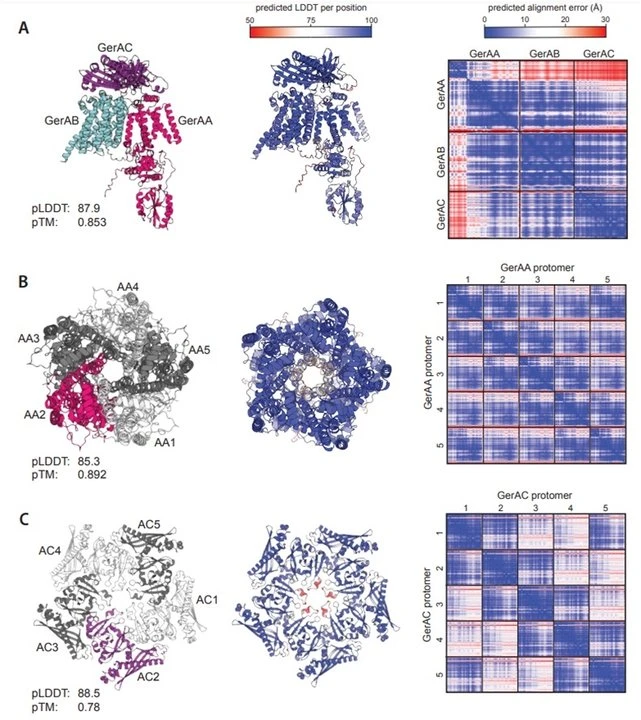
These authors used various methods to track the twists and turns of this mystery. They deployed artificial intelligence tools to predict the structure of this complex folded sensing protein complex, consisting of five copies of the same sensing protein. They apply machine learning to determine the interactions between the subunits that make up this ion channel. They also used genome editing technology to induce bacteria to produce sensor protein mutants, so as to test how computer-based prediction works in living cells.
Rudner said, "One thing I like about science is that when you make a discovery, all these irrelevant observations suddenly become meaningful. It's like when you're doing a puzzle, you find the position of a puzzle, and suddenly you can quickly fit another six puzzle pieces
Rudner described the discovery process in this study as a series of confusing observations that gradually took shape, thanks to the collaborative efforts of a group of researchers with different perspectives. During this process, they constantly had surprising and confusing observations, which hinted at some seemingly impossible answers.
Splicing clues together
When Rudner Laboratory researcher Yongqiang Gao conducted a series of experiments with Bacillus subtilis, an early clue emerged. Gao introduced the genes of other spore-forming bacteria into Bacillus subtilis to explore the idea that the mismatched proteins produced thereby would interfere with spore germination. To his surprise, Gao found that in some cases, dormant bacterial spores can perfectly awaken after using a set of proteins from distant bacteria.
During this study, Rudner Laboratory postdoctoral Lior Artzi provided an explanation for Gao's discovery. If this type of sensing protein is a receptor, it acts like a closed door before detecting a signal (in this case a nutrient such as sugar or amino acid). Once such sensing proteins bind to nutrients, they will open, allowing ions to flow out of the spores.
In other words, these proteins from bacteria with distant genetic relationships do not need to interact with mismatched spore proteins of Bacillus subtilis, but only respond to changes in the electrical state of the spores when ions begin to flow.
Rudner initially held a skeptical attitude towards this hypothesis, as such receptors did not fit this characteristic. They have almost no characteristics of ion channels. However, Artzi believes that such sensing proteins may be composed of multiple subunits and work together in a more complex structure.
Artificial intelligence showcases its skills
Rudner Laboratory postdoctoral Jeremy Amon is an early user of AlphaFold, an artificial intelligence tool that can predict the structure of proteins and protein complexes.
This artificial intelligence tool predicts the assembly of a specific receptor subunit into a pentamer ring. The predicted structure includes a channel located in the middle that allows ions to pass through the spore's membrane. The prediction of this artificial intelligence tool coincides with Artzi's guess.
Gao, Artzi, and Amon subsequently collaborated to test this artificial intelligence generated model. They worked closely with the postdoctoral Fernando Ram í rez Guadiana of Rudner Lab, Andrew Kruse, professor of biochemistry and molecular pharmacology of Harvard Medical School, and Deborah Marks, associate professor of system biology and computational biologist of Harvard Medical School.
They utilized the altered receptor subunits to modify the spores, which were expected to broaden this membrane ion channel and found that the spores would awaken without nutrient signals. In turn, they produced mutated receptor subunits, which they predicted would reduce the pore size of the ion channel. These spores failed to open the gate for releasing ions and were unable to awaken from their resting state even when sufficient nutrients induced them to break free from dormancy.
In other words, a slight deviation from the predicted configuration of the folded sensing protein complex can cause the ion pathway to open or close, making it useless as a tool for awakening dormant bacteria.
Impact on human health and food safety
Rudner said that understanding how dormant bacteria can restore life is not only a tempting intellectual challenge, but also has a significant impact on human health. Some bacteria that can enter a deep dormant state for a long time are dangerous, even deadly pathogens: the white powdery anthrax weapon is composed of bacterial spores.
Another dangerous pathogen that forms spores is Clostridium difficile, which causes life-threatening diarrhea and colitis. Diseases caused by Clostridium difficile infection usually occur after the use of antibiotics, which can kill many intestinal bacteria but have no effect on dormant spores. After treatment, Clostridium difficile awakens from its dormant state and may proliferate in large quantities, often resulting in catastrophic consequences.
Eliminating spores is also a core challenge for food processing plants, as dormant bacteria can resist disinfection treatment due to their protective shell and dehydrated state. If disinfection is not successful, spore germination and growth can cause serious foodborne diseases and huge economic losses.
Understanding how spores perceive nutrients and quickly break free from dormancy can enable scientists to develop methods that trigger spore germination earlier, potentially disinfecting bacteria or preventing spore germination, trapping them in their protective shells, preventing growth, proliferation, and causing food spoilage or disease.