AI can tell fortune or use AI to "calculate illness".
Pancreatic cancer has always been considered as the "king of cancer", usually "once found, it is late". If the risk of pancreatic cancer can be predicted 3 years in advance, it is undoubtedly a great blessing for pancreatic cancer patients.
On May 9, scientists from Copenhagen University and Harvard Medical School published a paper in Nature Medicine and trained a deep learning algorithm called CancerRiskNet. Only by providing AI with the patient's electronic medical record data, the risk of pancreatic cancer can be calculated. This algorithm can predict the risk of pancreatic cancer three years before it occurs, which can be called AI's "accurate fortune telling".
Dr. Yuan Bo, the lead author of the paper, said that the system only needs to be connected to the medical record system and does not need additional data collection. It is expected that the difficulty of landing is low and it is more suitable for large-scale promotion
In clinical medicine, both doctors and patients always turn pale when talking about pancreatic cancer.
Pancreatic cancer is a particularly deadly cancer. The survival rate of patients worldwide is only about 20% after one year and only 7% after five years. In addition to the high mortality rate, pancreatic cancer is extremely insidious and spreads very quickly. What's more cunning is that it usually has no obvious symptoms in the early stage. Therefore, it is not a joke that this kind of cancer "is late when it is found".
On May 9, 2023, researchers from Copenhagen University, Harvard Medical School and other institutions introduced artificial intelligence algorithms to solve the problem of early detection and treatment of pancreatic cancer, bringing new hope for the prevention and treatment of pancreatic cancer. The relevant paper was published in Nature Medicine, titled: A deep learning algorithm to predict risk of pancreatic cancer from disease trajectories.
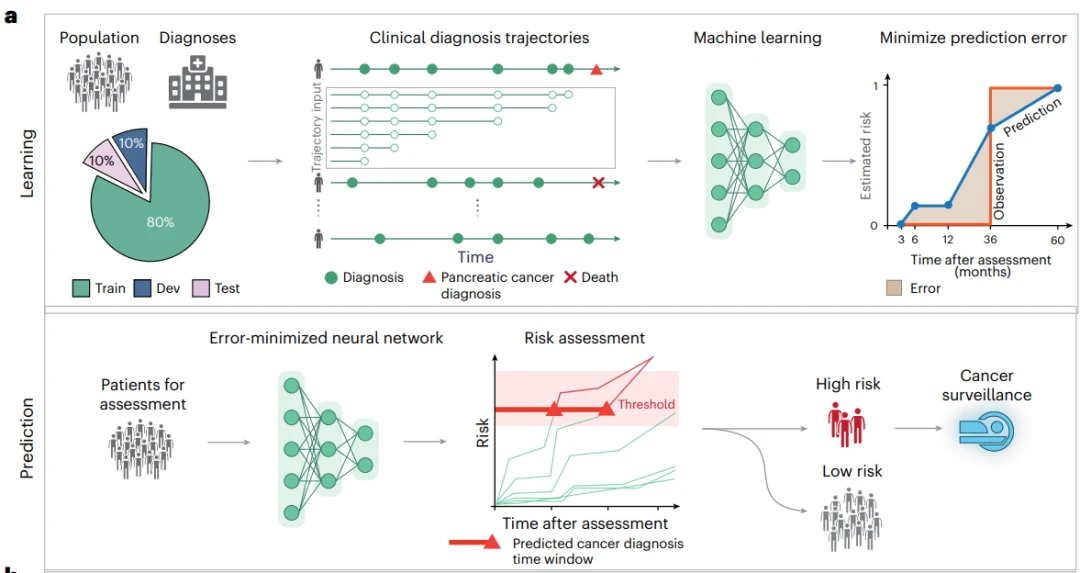
Specifically, the research team has developed a deep learning algorithm, called CancerRiskNet, which can predict the risk of patients due to pancreatic cancer.
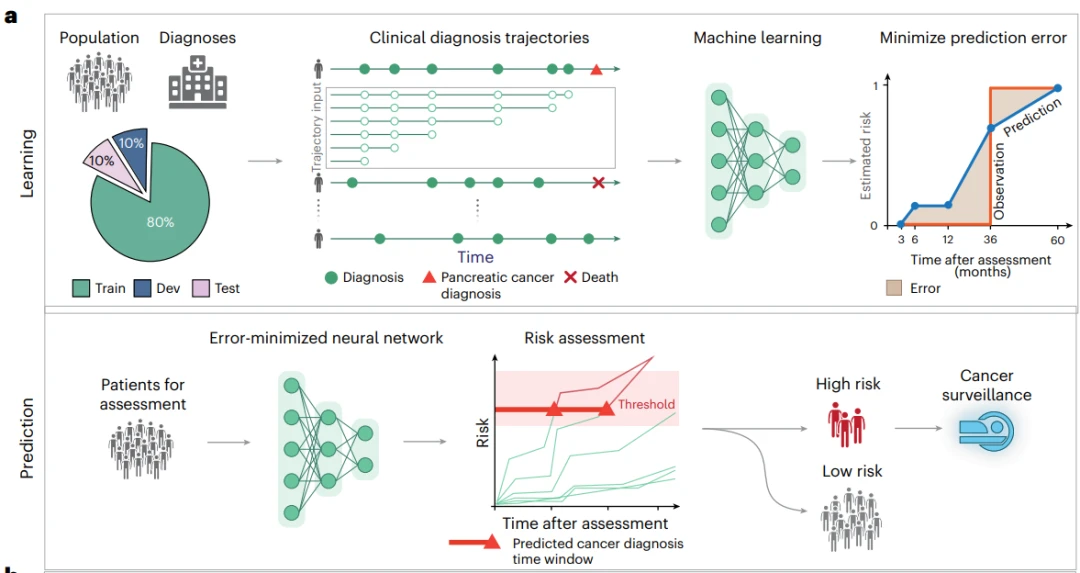
Training and predicting pancreatic cancer risk from disease trajectory
To verify the accuracy of the algorithm, the researchers used clinical data of more than 9 million patients from Denmark and the United States, including 24000 cases of pancreatic cancer.
Characteristics of patients in the United States and Denmark
Researchers used the electronic medical record data of pancreatic cancer patients to train CancerRiskNet and predict the risk of pancreatic cancer. The AUC value on the test set reached 0.86 (the closer the AUC value was to 1.0, the higher the authenticity of the detection method).
Compared to traditional screening, the accuracy of AI tools has been improved by 50-300 times after use.
In addition, unlike the commonly used imaging AI, this study only requires CancerRiskNet to be connected to the medical record system and does not require additional data collection. If image data is used, the screened object needs to be used for CT, so if this scheme is used on a large scale, the difficulty of implementation is lower and it is more suitable for large-scale promotion.
The new findings provide new ideas and methods for early detection and prevention of pancreatic cancer. Dr. Yuan Bo, the lead author of the paper, said that at present, there is no reliable biomarker or screening tool to detect early pancreatic pancreatic cancer. The purpose of this research is to develop an artificial intelligence tool to help clinicians identify high-risk groups of pancreatic cancer, so that these patients can benefit from early treatment.
Professor S ø ren Brunak of Biology at the University of Copenhagen stated that many types of cancer, especially those that are difficult to identify and treat early, cause disproportionate losses to patients, families, and the entire healthcare system. Artificial intelligence based screening will be an opportunity to change the development trajectory of pancreatic cancer.
Chris Sander, senior researcher of Harvard Medical School, said that this kind of AI tool can target those who have the highest risk of pancreatic cancer. They can benefit a lot from further tests, which will greatly help improve clinical decision-making.
It can be seen that with the help of artificial intelligence, medical personnel can not only find the risk of pancreatic cancer in patients at an early stage, improve the survival rate of patients, but also accurately target the "high-risk groups" that need more frequent screening and monitoring, so as to prevent the disease before it happens.