Parkinson's Disease (PD) is a common neurodegenerative disease that has become a serious problem worldwide. Typical clinical features of Parkinson's disease include motor manifestations such as bradykinesia, resting tremor, and postural instability. Although several physiological processes have been implicated in the pathogenesis of Parkinson's disease, several studies have reported a central role of mitochondrial dysfunction in the pathogenesis of Parkinson's disease.
Recently, researchers from the Department of Health Sciences, Graduate School of Dong-A University, Korea, published an article titled "Intranasal delivery of mitochondrial protein humanin rescues cell death and promotes mitochondrial function in Parkinson's disease" in Theranostics. promotes mitochondrial function in Parkinson's disease" in the journal Theranostics, which supports a novel role for the mitochondrial protein humanin in mitochondrial function and anti-Parkinson's disease neuronal survival, in which humanin treatment is sufficient to stimulate mitochondrial gene expression.
Mitochondrial dysfunction is a key factor in the pathogenesis of Parkinson's disease (PD). Therefore, many aspects of mitochondrial function have been investigated as possible therapeutic targets. In the present study, the investigators propose a novel strategy to promote mitochondrial function and prevent Parkinson's disease through a peptide encoded in the mitochondrial genome, the mitochondria-derived polypeptide (MDP) humanin (HN).
To test the possibility of humanin as a potential biomarker for Parkinson's disease, the investigators measured protein levels of circulating humanin in the plasma of Parkinson's disease patients and transgenic or neurotoxic mouse models of Parkinson's disease. As a next step, the investigators aimed to determine whether HN peptide treatment could modulate its activity or expression. Using a mouse model of Parkinson's disease, the investigators evaluated the entry of HN into the brain via the nasal route of administration. The investigators further revealed the possible mechanisms of HN peptide therapy for Parkinson's disease through in vitro and ex vivo Parkinson's disease models.
Although intracellular HN expression was not associated with PD, HN treatment itself induced intracellular HN expression and promoted mitochondrial biogenesis inducing mitochondrial gene expression. After nasal administration, HN peptides were neuroprotective and behaviorally restorative in an animal model of Parkinson's disease.
Interestingly, HN peptide after nasal administration was found in the brain, mainly through the trigeminal pathway. Mechanistically, HN induced activation of the phosphatidylinositol-3-kinase/protein kinase B (PI3K/AKT) signaling pathway, which promotes mitochondrial biogenesis and leads to the up-regulation of mitochondrial genes, including human proteins.
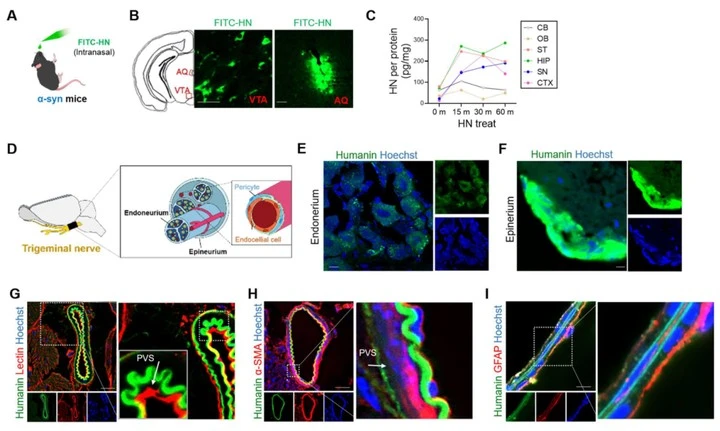
Nasal administration can reach the brain through the trigeminal nerve along the perivascular and perineural spaces
Image from:https://pubmed.ncbi.nlm.nih.gov/37351170/
The present study elucidated that exogenously treated HN peptide protects against PD by promoting mitochondrial biogenesis and thereby stimulating the expression of mitochondrial genes including human proteins.Therefore, enhancement of mitochondrial function with HN peptide may be a promising therapeutic approach for Parkinson's disease.