Malignant blood diseases are a group of cancers in which immunodeficient blood cells fail to differentiate and proliferate permanently, impairing the functioning of the living organism. They are divided into three main groups: lymphoma, multiple myeloma (MM) and leukemia. Malignant hematologic diseases are among the deadliest diseases with a high mortality rate, posing a major threat to human health and life.
Indeed, hematologic malignancies are unique in that they cannot be surgically removed as solid tumors, and most of their clinical first-line treatment consists of chemotherapy, radiation therapy, and hematopoietic stem cell transplantation. Despite the efficacy of standard first-line agents, the overall efficacy is not satisfactory due to the recurrent and refractory situation brought about by the emergence of primary and secondary drug resistance.
Recently, researchers from Johannes Gutenberg University published an article entitled "Cynaropicrin disrupts tubulin and c-Myc-related signaling and induces Cynaropicrin disrupts tubulin and c-Myc-related signaling and induces parthanatos-type cell death in multiple myeloma" in the journal Acta Pharmacologica Sinica, which shows that cynaropicrin has a potent inhibitory effect on hematopoietic tumor cells in vitro and in vivo.
Most hematologic malignancies are incurable and have unforeseen remission-recurrence pathways to different treatments. Sericin, a natural sesquiterpene lactone derived from the edible part of the artichoke plant, has received increasing attention as a chemotherapeutic agent.
In this study, the investigators examined the effects of cynarin on multiple myeloma (MM) cells in vitro and evaluated its in vivo effects in a xenograft tumor zebrafish model. The results showed that cynaropicrin had a strong cytotoxic effect on nine MM cell lines and two leukemia cell lines, of which the AMO1 cell line was the most sensitive (IC50=1.8±0.3µM).
Cynaropicrin (0.8, 1.9, 3.6µM) dose-dependently decreased c-Myc expression and transcriptional activity in AMO1 cells, which was associated with significant downregulation of STAT3, AKT and ERK1/2. Cell cycle analysis showed that after 24 h of Cynaropicrin treatment, AMO1 cells were arrested in the G2M phase with an increase in the sub-G0G1 phase. With the extension of treatment time, the cells were more aggregated in the sub-G0G1 phase, which implied cell death.
Under confocal microscopy, the researchers found that sena biturin disrupted the microtubule network of U2OS cells that stably expressed α-microtubulin-green fluorescent protein. Additionally, the researchers found that senaquorin promoted DNA damage in AMO1 cells through activation of PARP1, leading to the production of PAR aggregates, which resulted in the translocation of AIF from the mitochondria to the nucleus, leading to a new form of cell death, parathyroid hormone. Finally, in a zebrafish model of T-cell acute lymphoblastic leukemia (T-ALL) xenografts, the investigators demonstrated that xenopusin (5,10 micron) significantly reduced tumor growth.
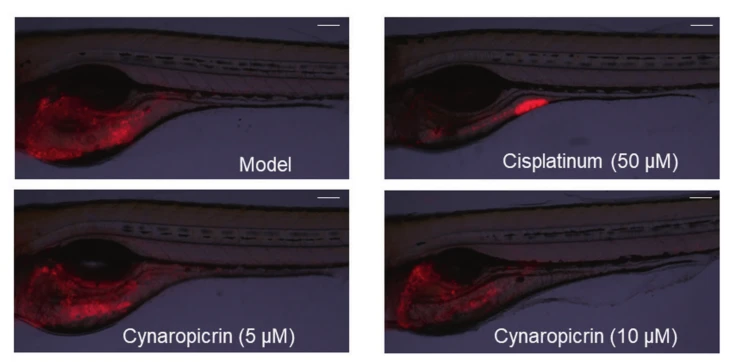
Acute cytotoxicity assay of bittersweet in zebrafish CCRF-CEM transplantation tumor model
Image from:https://doi.org/10.1038/s41401-023-01117-3
Taken together, the insights gained in the present study suggest that cynaropicrin is a natural product that effectively reduces tumor growth in zebrafish through de novo lethal cell death.Cynaropicrin also induces potential cytotoxicity in vitro through inhibition of c-Myc, and subsequently STAT3, AKT, and ERK1/2, as well as through inhibition of the microtubule protein network. The results of this study suggest that the potential therapeutic value of Cynaropicrin is a product of a new mode of cell death, parathyroid hormone.