In cells, DNA is packaged and compressed into the form of chromosomes, storing a vast amount of genetic information in a very small space. However, in recent years, researchers have discovered another type of DNA (extrachromosomal DNA, ecDNA) that is free from the chromosomal genome. This type of DNA typically exists in a circular form, not only carrying oncogenic genes, but also commonly present in many types of human tumors.
The expression of ecDNA in tumors can be described as a plethora of evil deeds. Because the structure of chromatin in ecDNA is more loose, it carries not only complete oncogene, but also promoter and enhancer sequences upstream of the gene, which makes the transcription activity of ecDNA higher and promotes the amplification of oncogene. On the other hand, due to the lack of centromere elements, ecDNA cannot be evenly distributed into offspring cells through mitosis, which enhances the heterogeneity of cells within the tumor and accelerates its evolution, making it easier to adapt to the environment and develop drug resistance. In addition, ecDNA can also travel around and come into contact with the entire genome, promoting the recombination of cellular genes.
It is generally believed that ecDNA does not exist in normal tissues. However, a recent article published in Nature, Extrachromosomal DNA in the cancer transformation of Barrett's oesophagus, pointed out that ecDNA has already appeared in tissues that have not yet undergone cancer, indicating that its role may be more terrifying than previously thought, as it can drive tissues towards cancer before cancer cells appear.
The expression of ecDNA in tumors can be described as a plethora of evil deeds. Because the structure of chromatin in ecDNA is more loose, it carries not only complete oncogene, but also promoter and enhancer sequences upstream of the gene, which makes the transcription activity of ecDNA higher and promotes the amplification of oncogene. On the other hand, due to the lack of centromere elements, ecDNA cannot be evenly distributed into offspring cells through mitosis, which enhances the heterogeneity of cells within the tumor and accelerates its evolution, making it easier to adapt to the environment and develop drug resistance. In addition, ecDNA can also travel around and come into contact with the entire genome, promoting the recombination of cellular genes.
It is generally believed that ecDNA does not exist in normal tissues. However, a recent article published in Nature, Extrachromosomal DNA in the cancer transformation of Barrett's oesophagus, pointed out that ecDNA has already appeared in tissues that have not yet undergone cancer, indicating that its role may be more terrifying than previously thought, as it can drive tissues towards cancer before cancer cells appear.
In the study, researchers analyzed whole genome sequencing data from two groups of Barrett's oesophagus patients and esophageal adenocarcinoma (EAC) patients from the UK and the United States. Due to the frequent biopsy of Barrett's esophagus patients, researchers are able to collect tissue samples before the onset of cancer.
Barrett's esophagus often occurs in patients with gastroesophageal reflux disease. As gastric acid and enzymes often reflow back to the esophagus, the chronic damage caused will make some people's esophageal inner wall cells change. In a few patients with Barrett's esophagus, with more and more genetic abnormalities and structural changes in the cells of the inner wall of the esophagus, it has developed from low dysplasia to high dysplasia before canceration. During this process, certain genes with tumor suppressive functions may undergo mutations or deletions, leading to whole genome replication, genomic instability, or catastrophic chromosomal rearrangement, ultimately developing into esophageal adenocarcinoma. ECDNA also appears in the changing cells during this process.
Barrett's esophagus often occurs in patients with gastroesophageal reflux disease. As gastric acid and enzymes often reflow back to the esophagus, the chronic damage caused will make some people's esophageal inner wall cells change. In a few patients with Barrett's esophagus, with more and more genetic abnormalities and structural changes in the cells of the inner wall of the esophagus, it has developed from low dysplasia to high dysplasia before canceration. During this process, certain genes with tumor suppressive functions may undergo mutations or deletions, leading to whole genome replication, genomic instability, or catastrophic chromosomal rearrangement, ultimately developing into esophageal adenocarcinoma. ECDNA also appears in the changing cells during this process.
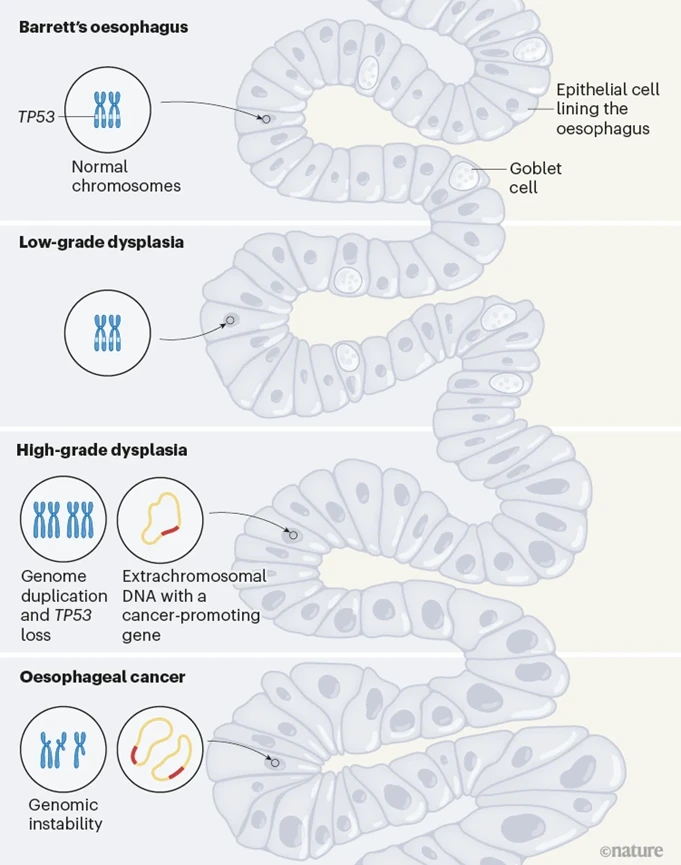
Barrett's esophagus gradually develops into esophageal adenocarcinoma
Researchers are trying to determine whether these ecDNA, which appear alongside disease progression, are products of genomic instability or the driving force behind atypical hyperplasia and ultimately falling off the cancer cliff.
It was found that in the patient group from the UK, those in the Barrett's esophagus stage and the Barrett's esophagus low-grade dysplasia stage did not detect ecDNA. In contrast, 4%, 25%, and 43% of patients in the highly dysplastic stage, early cancer stage, and late cancer stage have detected ecDNA, respectively. This indicates that ecDNA appears in the highly dysplastic stage before cancer progression, and as the cancer progresses, the situation becomes increasingly severe.
For a group of patients from the United States, researchers conducted years of follow-up and conducted sample biopsies at different time points. The results showed that among patients who eventually developed cancer, 20% of patients discovered ecDNA before cancer diagnosis, while among patients who did not develop cancer, the proportion of discovered ecDNA was only 2.5%. In addition, long-term follow-up of 10 patients who did not detect ecDNA revealed that nearly 10 years later, they had not yet developed into highly atypical hyperplasia or esophageal adenocarcinoma. This indicates that the presence of ecDNA is closely related to the development of esophageal adenocarcinoma.
In addition, researchers also found that although ecDNA appears after mutations in the well-known tumor suppressor gene TP53, its appearance can be independent of the occurrence of whole genome replication or chromosomal fragmentation, which is not the formation mechanism of ecDNA. When more histological abnormalities are observed under a microscope, the structural complexity and copy number of ecDNA are also higher. 31% of the people detected more than one ecDNA, and one third of the ecDNA contained more than one oncogene, including some immune regulator gene. These all indicate that ecDNA plays a driving role in the transformation of Barrett's esophagus into cancer.
It was found that in the patient group from the UK, those in the Barrett's esophagus stage and the Barrett's esophagus low-grade dysplasia stage did not detect ecDNA. In contrast, 4%, 25%, and 43% of patients in the highly dysplastic stage, early cancer stage, and late cancer stage have detected ecDNA, respectively. This indicates that ecDNA appears in the highly dysplastic stage before cancer progression, and as the cancer progresses, the situation becomes increasingly severe.
For a group of patients from the United States, researchers conducted years of follow-up and conducted sample biopsies at different time points. The results showed that among patients who eventually developed cancer, 20% of patients discovered ecDNA before cancer diagnosis, while among patients who did not develop cancer, the proportion of discovered ecDNA was only 2.5%. In addition, long-term follow-up of 10 patients who did not detect ecDNA revealed that nearly 10 years later, they had not yet developed into highly atypical hyperplasia or esophageal adenocarcinoma. This indicates that the presence of ecDNA is closely related to the development of esophageal adenocarcinoma.
In addition, researchers also found that although ecDNA appears after mutations in the well-known tumor suppressor gene TP53, its appearance can be independent of the occurrence of whole genome replication or chromosomal fragmentation, which is not the formation mechanism of ecDNA. When more histological abnormalities are observed under a microscope, the structural complexity and copy number of ecDNA are also higher. 31% of the people detected more than one ecDNA, and one third of the ecDNA contained more than one oncogene, including some immune regulator gene. These all indicate that ecDNA plays a driving role in the transformation of Barrett's esophagus into cancer.
The study also found a highly representative case: this American patient underwent four biopsies over a period of 7 years. At first, the patient was in a highly dysplastic stage, and TP53 was indeed present, but no ecDNA was detected. Five years later, it was still a stage of highly atypical hyperplasia, but a single type of ecDNA appeared. Six months later, the person developed cancer and detected a second type of ecDNA. Researchers analyzed the excised tumors and found that the tumors contained two types of ecDNA, while the remaining highly atypical hyperplasia only contained the first type of ecDNA. This led researchers to conclude that the second type of ecDNA leads to the transition from dysplasia to cancer.
Although this study is mainly based on clinical observations, the large number of individuals included in the study covers the entire progression from Barrett's esophagus to cancer. Research has confirmed that ecDNA can indeed appear in precancerous tissues and make them more prone to cancer transformation, indicating that ecDNA can serve as a target for early intervention or treatment to develop related therapies.
Senior author of the study Paul Mischel, a professor of pathology at Stanford University, stated: "In the past, researchers often DNA sequencing multiple parts of a tumor, and draw an evolutionary tree to analyze which mutations are key driving events and which are branching events that occur in the late stage of tumor development. However, because ecDNA is randomly distributed in offspring cells, it behaves more like late events on the evolutionary tree, leading people to mistakenly believe that ecDNA is not a good target for treatment. But our research found that this principle The solution is wrong
In the future, the research team will further explore how to improve the ability to detect ecDNA, whether there are ways to prevent the formation or activity of ecDNA, how ecDNA affects the immune system, and whether new therapies can be developed around ecDNA.
Although this study is mainly based on clinical observations, the large number of individuals included in the study covers the entire progression from Barrett's esophagus to cancer. Research has confirmed that ecDNA can indeed appear in precancerous tissues and make them more prone to cancer transformation, indicating that ecDNA can serve as a target for early intervention or treatment to develop related therapies.
Senior author of the study Paul Mischel, a professor of pathology at Stanford University, stated: "In the past, researchers often DNA sequencing multiple parts of a tumor, and draw an evolutionary tree to analyze which mutations are key driving events and which are branching events that occur in the late stage of tumor development. However, because ecDNA is randomly distributed in offspring cells, it behaves more like late events on the evolutionary tree, leading people to mistakenly believe that ecDNA is not a good target for treatment. But our research found that this principle The solution is wrong
In the future, the research team will further explore how to improve the ability to detect ecDNA, whether there are ways to prevent the formation or activity of ecDNA, how ecDNA affects the immune system, and whether new therapies can be developed around ecDNA.