In a new study, researchers from Case Western Reserve University and Metro Health Hospital in the United States have succeeded in unraveling the mystery of a protein receptor --- EphA2 --- that both inhibits cancer and promotes its growth and spread. The findings highlight how and why the EphA2 receptor plays the dual role of fighting cancer and promoting it. The findings are published in the December 1, 2023 issue of Science under the title "Time-resolved live-cell spectroscopy reveals EphA2 multimeric assembly". The new study was led by Bingcheng Wang, a professor at Case Western Reserve University School of Medicine.
Discoveries like this make it possible to treat cancer," Wang said. As a cancer researcher, there is no greater accomplishment... But the greatest reward is knowing that the advances we are making will have a real impact on our own patients and others around the world."
A pioneer in EphA2 research for 25 years, Wang has made great strides in the field, discovering the receptor's ability to inhibit the behavior of malignant tumors in 2000 and its role in promoting carcinogenesis after modification with tumor-associated proteins in 2009. Modified EphA2 causes cancer cells to proliferate, maintain stem cell properties, and metastasize to other parts of the body, he said.
Now, after years of research, these authors have figured out how EphA2 plays these dual, opposite roles in cancer. Using a cutting-edge spectroscopy platform (PIE-FCCS) to molecularly analyze living cells, they found that EphA2 auto-assembles into clusters through two interactions between neighboring EphA2 molecules, "sticking" them together. One of these interactions contributes to cancer-fighting effects, while the other triggers their cancer-promoting effects.
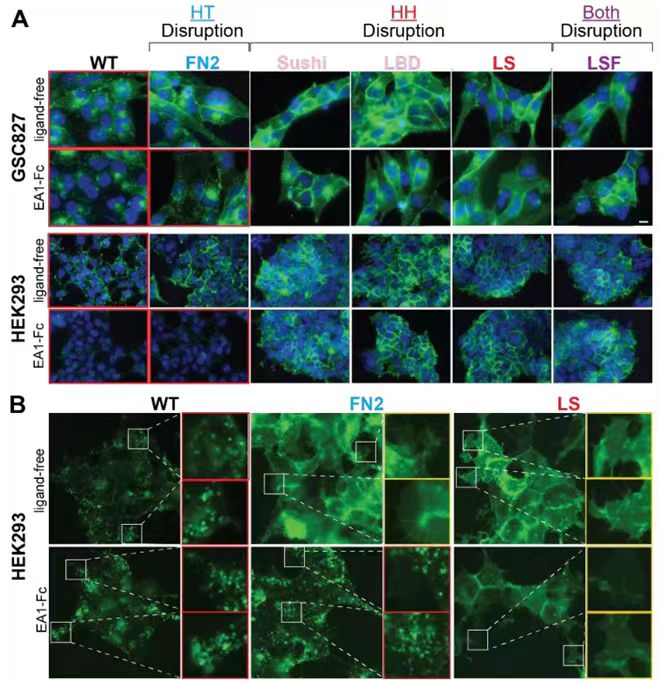
Image from Science, 2023, doi:10.1126/science.adg5314.
Xiaojun Shi, co-author of the paper and a postdoctoral scholar at Case Western Reserve University, combined molecular imaging expertise with experimental skills in cancer biology to make the discovery possible. John Chae, senior associate dean for medical affairs at Case Western Reserve University School of Medicine, spoke about the significance of the discovery.
This is the kind of basic research that life-saving therapies depend on," Chae said. We are fortunate to have an internationally respected researcher like Dr. Wang and the terrific team he has assembled."