Researchers from Monash University, Australia, and Harvard University, USA, published a research paper titled " Association of the Sleep Regularity Index With Incident Dementia and Brain Volume" in the journal Neurology.
The study showed that people with irregular sleep have a higher risk of developing dementia, with those with the lowest sleep regularity scores having a 53% higher risk of developing dementia compared to those with average sleep regularity. Simply put, a sleep pattern of going to bed at 10pm tonight, going to bed at 11pm tomorrow night, and staying up late the day after may increase the risk of dementia.
In this study, researchers analyzed 88,094 participants in the UK Biobank database, with an average age of 62 years and 56% female, and collected sleep data from the participants by wearing a wrist-worn device. The Sleep Regularity Index (SRI) was used to calculate the sleep patterns of the participants, which is the consistency of the sleep-wake pattern from day to day, and to analyze the association between the sleep patterns and the risk of dementia. Association.
A total of 480 cases of dementia were recorded during an average follow-up period of 7.2 years.
The study found an association between sleep regularity scores and dementia risk, with those with the least regular sleep having the highest risk of developing dementia compared to those with average sleep regularity.
Specifically, participants had an average sleep regularity score of 60, with those in the lowest 5% of scores being the least regular sleepers with an average score of 41, and those in the highest 5% of scores being the most regular sleepers with an average score of 71. Those who were the least regular sleepers had the highest risk of developing dementia compared to the average sleep regularity scores, which were 53% higher.
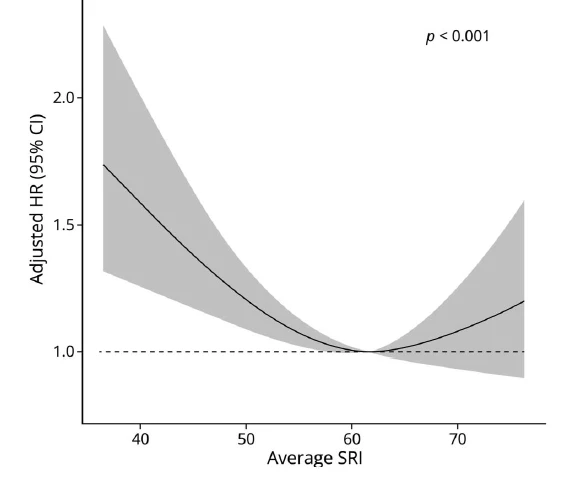
Sleep Regularity Score Linked to Dementia
The researchers said that according to the study data, dementia can be prevented by simply increasing sleep regularity to an average level for people who do not sleep regularly.
Nonetheless, the researchers emphasized that this was an observational study and did not show a causal relationship between regular sleep and dementia risk, and further research is needed.
It is worth mentioning that researchers from Augusta University, USA, and City University of Hong Kong, China, published an article in the journal " Sleep Health" entitled " Day-to-day deviations in sleep parameters and biological aging: findings from the NHANES 2011-2014" research paper.
The study shows that maintaining regular sleep habits can help slow down the biological aging process. Participants with greater deviations in bedtime and large differences in weekday and weekend sleep were nine months older in biological age compared to those with stable sleep habits.